
Kia Cadenza YG: Engine Control System / Canister Close Valve (CCV) Repair procedures
Kia Cadenza YG 2016-2021 Service Manual / Engine Control / Fuel System / Engine Control System / Canister Close Valve (CCV) Repair procedures
| Inspection |
| 1. |
Turn the ignition switch OFF. |
| 2. |
Disconnect the CCV connector. |
| 3. |
Measure resistance between the CCV terminal 1 and 2. |
| 4. |
Check that the resistance is within the specification.
|
| 5. |
Disconnect the vapor hose connected with the canister from the CCV. |
| 6. |
Connect a vacuum pump to the nipple. |
| 7. |
Ground the CCV control line and apply battery voltage to the CCV power supply line. |
| 8. |
Apply vacuum and check the valve operation.
|
| Removal |
| 1. |
Turn the ignition switch OFF and disconnect the battery negative (-) cable. |
| 2. |
Lift the vehicle. |
| 3. |
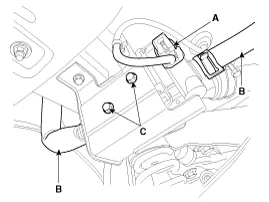
Disconnect the canister close valve connector (A). |
| 4. |
Disconnect the ventilation hose (B) from the fuel tank air filter and canister close valve. |
| 5. |
Remove the fuel tank air filter assembly after removing bolts (C).
|
| 6. |
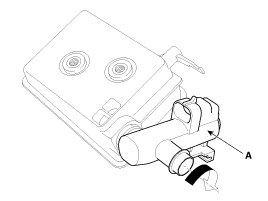
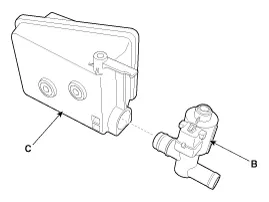
Release the lever (A), and then separate the canister close
valve (B) from the fuel tank air filter (C) after rotating it in the
direction of the arrow in the figure.
|
| Installation |
| • |
Install the component with the specified torques. |
| • |
Note that internal damage may occur when the component is dropped. In this case, use it after inspecting. |
| 1. |
Install in the reverse order of removal. |
Circuit Diagram
Other information:
Kia Cadenza YG 2016-2021 Service Manual: Pantoscopic Camera Components and Components Location
C
Kia Cadenza YG 2016-2021 Service Manual: Photo Sensor Repair procedures
Inspection 1. Ignition "ON" 2. Using the scan tool. 3. Emit intensive light toward photo sensor using a lamp, and check the output voltage change. 4. The voltage will rise with higher intensive light and reduce with lower intensive light.
Categories
- Manuals Home
- Kia Cadenza Owners Manual
- Kia Cadenza Service Manual
- Schematic Diagrams
- Automatic Transaxle System
- Brake System
- New on site
- Most important about car

Copyright © 2026 www.kcadenzavg.com - 0.0231