
Kia Cadenza YG: ESC(Electronic Stability Control) System / EBD(Electronic Brake-force Distribution) Description and Operation
Kia Cadenza YG 2016-2021 Service Manual / Brake System / ESC(Electronic Stability Control) System / EBD(Electronic Brake-force Distribution) Description and Operation
| Operation |
The EBD system (Electronic Brake force Distribution) as a
sub-system of the ABS system is to control the maximum braking
effectiveness by the rear wheels.
It further utilizes the efficiency of highly developed ABS
equipment by controlling the slip of the rear wheels in the partial
braking range.
The brake force is moved even closer to the optimum and
controlled electronically, thus dispensing with the need for the
proportioning valve.
The proportioning valve, because of a mechanical device, has
limitations to achieve an ideal brake force distribution to the rear
wheels as well as to carry out the flexible brake force distribution
proportioning to the vehicle load or weight increasing. And in the event
of malfunctioning, driver cannot notice whether it fails or not.
EBD controlled by the ABS Control Module, calculates the slip
ratio of each wheel at all times and controls the brake pressure of the
rear wheels not to exceed that of the front wheels.
If the EBD fails, the EBD warning lamp (Parking brake lamp) lights up.
Advantages
| – |
Function improvement of the base-brake system. |
| – |
Compensation for the different friction coefficients. |
| – |
Elimination of the proportioning valve. |
| – |
Failure recognition by the warning lamp. |
Comparison between Proportioning Valve and EBD
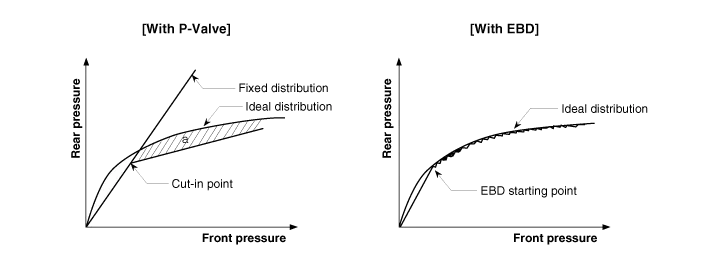
Failure Diagnosis 1. In principle, ESC and TCS controls are prohibited in case of ABS failure. 2. When ESC or TCS fails, only the failed system control is prohibited.
Components (1) 1. Front - left tube2. Rear - right tube3. Rear - left tube4. Front - right tube5. MC26. MC17. ESC control module (HECU)8. Damper9.
Other information:
Kia Cadenza YG 2016-2021 Service Manual: Description and Operation
Description System Overview The System offers the following features: – Human / machine interface through a 1-stage button, for terminal switching and engine start. – Control of external relays for ACC / IGN1 / IGN2 terminal switching and STARTER, without use of mechanical ignition switch.
Kia Cadenza YG 2016-2021 Service Manual: Components and Components Location
C
Categories
- Manuals Home
- Kia Cadenza Owners Manual
- Kia Cadenza Service Manual
- Restraint
- Suspension System
- Schematic Diagrams
- New on site
- Most important about car

Copyright © 2026 www.kcadenzavg.com - 0.0247