
Kia Cadenza YG: Fuel Delivery System / Delivery Pipe Repair procedures
| Removal |
In case of removing the high pressure fuel pump, high
pressure fuel pipe, delivery pipe, and injector, there may be injury
caused by leakage of the high pressure fuel. So don’t do any repair
work right after engine stops.
|

| 1. |
Turn the ignition switch OFF and disconnect the battery negative (-) cable. |
| 2. |
Release the residual pressure in fuel line.
(Refer to the Fuel Delivery System - Repair Procedures - "Release Residual Pressure in Fuel Line").
|

| 3. |
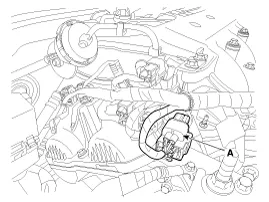
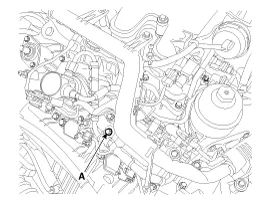
Disconnect the injectors & rail pressure sensor connector (A).
|
| 4. |
Remove the intake manifold.
(Refer to Engine Mechanical System - "Intake Manifold") |
| 5. |
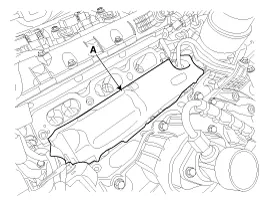
Remove the injector foam (A).
|
| 6. |
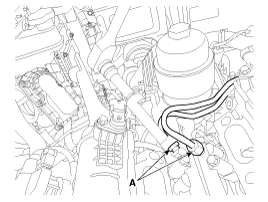
Remove the high pressure fuel pipe.
|

| 7. |
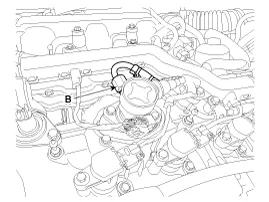
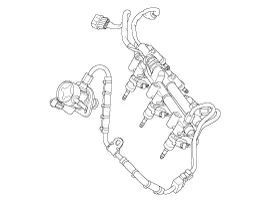
Remove the installation bolt (A), and then remove the delivery pipe and injector assembly from the engine.
|

| Installation |
|
|
|
|
|
|

 →
→  →
→  ) in several cycles up to the specified torque.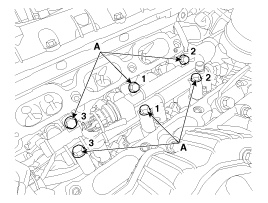
| 1. |
Install in the reverse order of removal.
|
Removal 1. Turn the ignition switch OFF and disconnect the negative (-) battery cable. 2. Disconnect the accelerator position sensor connector (A).
Removal In case of removing the high pressure fuel pump, high pressure fuel pipe, delivery pipe, and injector, there may be injury caused by leakage of the high pressure fuel.
Other information:
Kia Cadenza YG 2016-2021 Service Manual: Description and Operation
Description System Operation Typically, lane departure warning is activated at a speed over 70 KPH, but suppressed in case of unintentional lane departure when driver do not operate turn signal. System Operation Conditions 1. User Conditions (1) When unintended lane departure is occured, warnings are generated.
Kia Cadenza YG 2016-2021 Service Manual: Heater Unit Repair procedures
Replacement 1. Disconnect the negative (-) battery terminal. 2. Recover the refrigerant with a recovery/ recycling/ charging station. 3. When the engine is cool, drain the engine coolant from the radiator. 4. Remove the expansion valve cover (A).
Categories
- Manuals Home
- Kia Cadenza Owners Manual
- Kia Cadenza Service Manual
- Steering System
- Crankshaft Damper Pulley Components and Components Location
- Body (Interior and Exterior)
- New on site
- Most important about car
