
Kia Cadenza YG: Parking Brake System / Electric Parking Brake (EPB) Schematic Diagrams
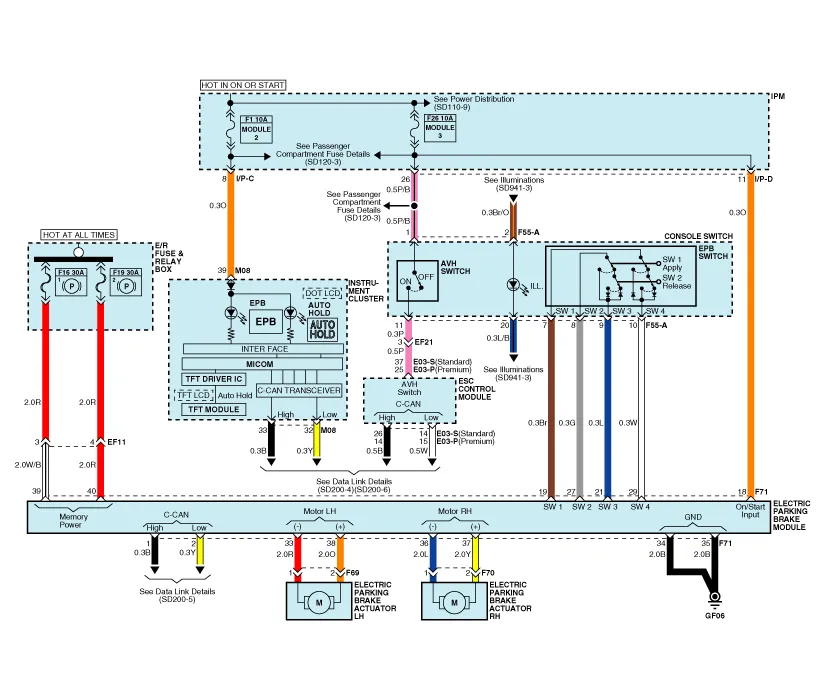
| EPB Circuit Diagram |
| EPB connector input/output |
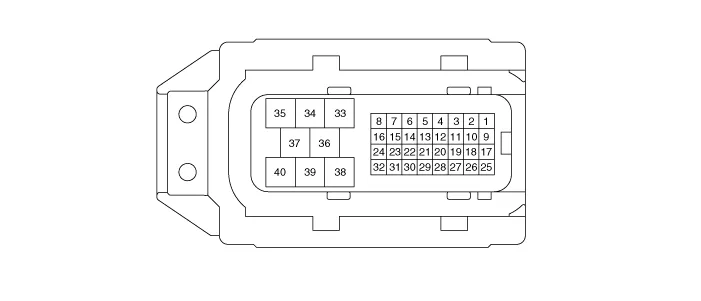
| Pin No. | Description |
| 1 | CAN_High |
| 2 | CAN_Low |
| 18 | IGN (+) |
| 19 | EPB Switch Signal 1 |
| 21 | EPB Switch Signal 3 |
| 27 | EPB Switch Signal 2 |
| 29 | EPB Switch Signal 4 |
| 33 | Rear Left Motor (-) |
| 34 | Ground |
| 35 | Ground |
| 36 | Rear Right Motor (-) |
| 37 | Rear Right Motor (+) |
| 38 | Rear Left Motor (+) |
| 39 | Battery (Rear Right Motor) |
| 40 | Battery (Rear Left Motor) |
Description The EPB is an electronic parking brake. The EPB is different from existing parking systems which operated with the brake pedal or the lever type.
Removal 1. Turn ignition OFF and disconnect the negative (-) battery cable. 2. Remove the crash pad lower panel and reinforcing panel (A). (Refer to the Body group - “Crash pad”) 3.
Other information:
Kia Cadenza YG 2016-2021 Service Manual: Adaptive Front Lighting System Repair procedures
Removal 1. Disconnect the negative (-) battery terminal. 2. Using a screwdriver or remover, remove the crash pad side cover (A). [RH] 3. Disconnect the stopper (B) from the glove box (A). 4. Disconnect the air damper (A) from the glove box (B).
Kia Cadenza YG 2016-2021 Service Manual: Intake Actuator Repair procedures
Inspection 1. Ignition "OFF". 2. Disconnect the intake actuator connector. 3. Verify that the actuator operates to the recirculation position when connecting 12V to the terminal 3 and grounding terminal 7. 4. Verify that the intake actuator operates to the fresh position when connecting in the reverse.
Categories
- Manuals Home
- Kia Cadenza Owners Manual
- Kia Cadenza Service Manual
- Components and Components Location
- Engine Control / Fuel System
- Automatic Transaxle System
- New on site
- Most important about car
