
Kia Cadenza YG: Fuel Delivery System / Fuel Tank Repair procedures
| Removal |
| 1. |
Release the residual pressure in fuel line.
(Refer to the Fuel Delivery System - Repair Procedures - "Release Residual Pressure in Fuel Line"). |
| 2. |
Remove the floor mat after open the trunk. |
| 3. |
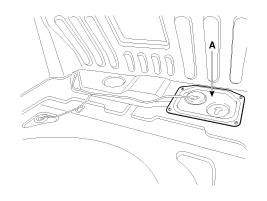
Remove the fuel pump service cover (A) in the trunk.
|
| 4. |
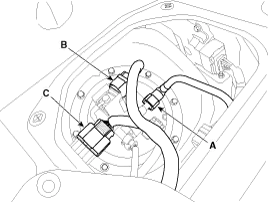
Disconnect the fuel feed tube quick-connector (A). |
| 5. |
Disconnect the fuel tank pressure sensor connector (B). |
| 6. |
Disconnect the fuel pump control module & fuel pump extension connector (C).
|
| 7. |
Lift the vehicle. |
| 8. |
Remove the main muffer. (Refer to Engine Mechanical System - "Muffler") |
| 9. |
Support the fuel tank with a jack. |
| 10. |
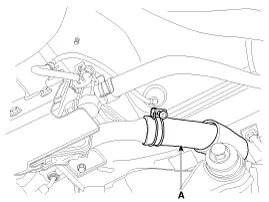
Disconnect the fuel filler hose (A).
|
| 11. |
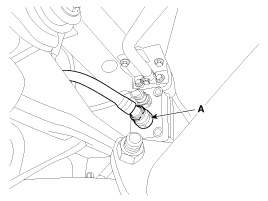
Disconnect the vapor hose quick-connector (A).
|
| 12. |
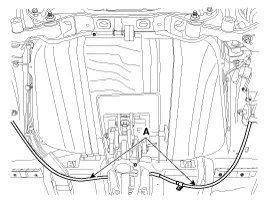
Remove the parking brake line (A). [NON - EPB type]
|
| 13. |
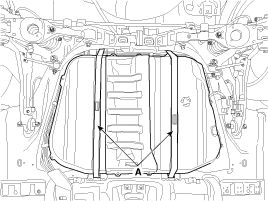
Remove the fuel tank bands (A) installation nuts.
|
| 14. |
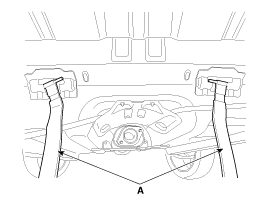
Remove the fuel tank after removing the fuel tank band (A) as below.
|
| Installation |
| 1. |
Install in the reverse order of removal.
|
Fuel Pressure Test (Low pressure system) 1. Release the residual pressure in fuel line. (Refer to the Fuel Delivery System - Repair Procedures - "Release Residual Pressure in Fuel Line").
Inspection [Fuel pump] 1. Turn the ignition switch OFF, and then remove battery (-) cable. 2. Remove the fuel pump assembly. 3. Check that motor operates properly when applying battery voltage to terminals 2 and 4 of fuel pump connector (A).
Other information:
Kia Cadenza YG 2016-2021 Service Manual: Height Sensor Repair procedures
Removal Height Sensor 1. Disconnect the negative (-) battery terminal. 2. Remove the height sensor linkage (A) installed on the front axle and rear axle. [Front] [Rear] Installation Height Sensor 1. Install the height sensor assembly after connecting the connector.
Kia Cadenza YG 2016-2021 Service Manual: Climate Control Air Filtar Repair procedures
Replacement 1. Disconnect the damper (B) from the glove box (A) and then remove the glove box lift (C). 2. Remove the filter cover (A) with pushing the knob. 3. Replace the air filter (B), install it after making sure of the direction of air filter.
Categories
- Manuals Home
- Kia Cadenza Owners Manual
- Kia Cadenza Service Manual
- Emission Control System
- Restraint
- Automatic Transaxle System
- New on site
- Most important about car
