
Kia Cadenza YG: SRSCM / SRS Control Module (SRSCM) Repair procedures
Kia Cadenza YG 2016-2021 Service Manual / Restraint / SRSCM / SRS Control Module (SRSCM) Repair procedures
| Removal |
| 1. |
Remove the ignition key from the vehicle. |
| 2. |
Disconnect the battery negative cable and wait for at least three minutes before beginning work. |
| 3. |
Remove the floor console. (Refer to the Body group - console) |
| 4. |
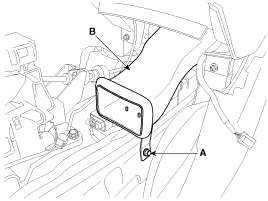
After removing the bolt (A), remove the rear vent duct (B).
|
| 5. |
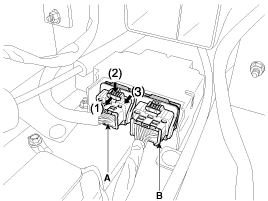
Pull the lock (1) forward and the pull the lever (3) after pressing the lever lock (2).
Disconnect the SRSCM connector (A) and (B).
|
| 6. |
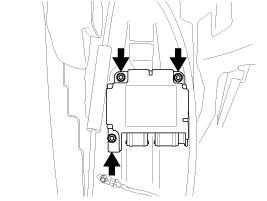
Remove the SRSCM mounting bolts(3EA) from the SRSCM, then remove the SRSCM. |
| Installation |
| 1. |
Remove the ignition key from the vehicle. |
| 2. |
Disconnect the battery negative cable and wait for at least three minutes before beginning work. |
| 3. |
Install the SRSCM with the SRSCM mounting bolts.
|

| 4. |
Connect the SRSCM harness connector. |
| 5. |
Install the rear vent duct and floor console. (Refer to the Body group - console) |
| 6. |
Reconnect the battery negative cable. |
| 7. |
After installing the SRSCM, confirm proper system operation:
|
| Variant coding |
After replacing the SRSCM, the “Variant Coding” must be performed.
|
Variant coding Procedure
Description The front impact sensor (FIS) is installed in the Front End Module (FEM). They are remote sensors that detect acceleration due to a collision at its mounting location.
Other information:
Kia Cadenza YG 2016-2021 Service Manual: Blind Spot Detection Switch Repair procedures
Removal 1. Disconnect the negative (-) battery terminal. 2. Remove the passenger compartment junction box cover. 3. Remove the driver side cover (A). 4. Remove the crash pad side switch assembly (A) by pushing it through side cover hole.
Kia Cadenza YG 2016-2021 Service Manual: Heater & A/C Control Unit (DATC) Components and Components Location
C
Categories
- Manuals Home
- Kia Cadenza Owners Manual
- Kia Cadenza Service Manual
- Engine Mechanical System
- Schematic Diagrams
- Restraint
- New on site
- Most important about car

Copyright © 2026 www.kcadenzavg.com - 0.0213