
Kia Cadenza YG: Lighting System / Room Lamp Repair procedures
| Inspection |
| 1. |
Check that the switch operates properly after disconnecting the room lamp connector (A).
|


| Removal |
| 1. |
Disconnect the negative(-) battery terminal. |
| 2. |
Carefully remove the lens (A) using a small screwdriver.
|

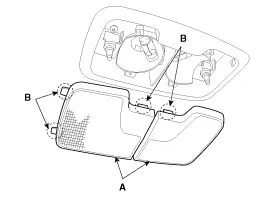
| 3. |
Remove the bulb (A) and room lamp after loosening the mounting screws.
|

| 4. |
Remove the room lamp assembly (A) from the head lining after disconnecting the connector (B).
|

| 1. |
Disconnect the negative (-) battery terminal. |
| 2. |
Remove the vanity lamp (A) by pressing the clip (B) with a flat-tip screwdriver.
|

| 3. |
Replace the bulb. |
| Installation |
| 1. |
Reconnect the connector. |
| 2. |
Install the room lamp assembly. |
| 3. |
Install the lens. |
| 1. |
Reconnect the vanity lamp connector. |
| 2. |
Install the vanity lamp. |
Inspection 1. Check-points upon head lamp failure (HID) (1) Check the battery voltage. (Low beam will be on when the battery voltage above 9V.) (2) Check the fuse and relay.
Inspection Overhead Console Lamp Remove the overhead console lamp assembly then check for continuity between terminals. If the continuity is not as specified, replace the map lamp switch.
Other information:
Kia Cadenza YG 2016-2021 Service Manual: Repair procedures
Inspection Initialization and diagnosis sequence by using diagnostic equipment Below content summarize the procedure for A/S using Diagnostic equipment Download Parameter 1. Select "AFLS" menu after selecting a vehicle. 2. Select "Parameter download" menu for define a characteristc of vehicle.
Kia Cadenza YG 2016-2021 Service Manual: Parking Assist Sensor Repair procedures
Removal 1. Disconnect the negative (-) battery terminal. 2. Remove the rear bumper cover. (Refer to Body - "Rear Bumper Cover") 3. Disconnect the connector (A) from the parking assist sensor. 4. Pull out the sensor (A) by opening the sensor holder (B) out.
Categories
- Manuals Home
- Kia Cadenza Owners Manual
- Kia Cadenza Service Manual
- Engine Electrical System
- Battery Troubleshooting
- Body Electrical System
- New on site
- Most important about car
