
Kia Cadenza YG: Horn / Repair procedures
| Inspection |
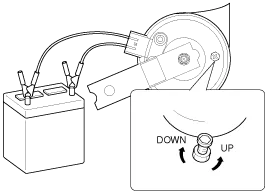
Test the horn by connecting battery voltage to the 1 terminal and ground the 2 terminal.
The horn should make a sound. If the horn fails to make a sound, replace it.
Horn Relay Inspection
| 1. |
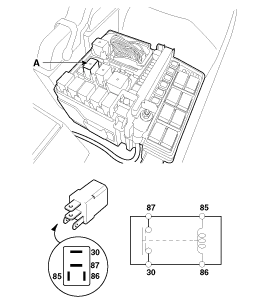
Remove the horn relay (A) from the engine room relay box. |
| 2. |
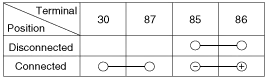
There should be continuity between the No.30 and No.87
terminals when power and ground are connected to the No.85 and No.86
terminals. |
| 3. |
There should be no continuity between the No.30 and No.87 terminals when power is disconnected.
|
| Removal |
| 1. |
Remove the radiator grill upper gide.
(Refer to Body - "Front Bumper") |
| 2. |
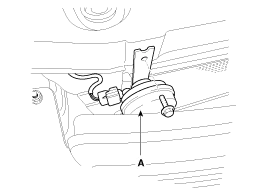
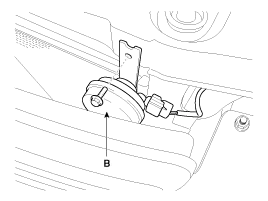
Remove the mounting nut and disconnect the horn connector, then remove the high pitch horn (A) and low pitch horn (B).
|
| Installation |
| 1. |
Connect the horn connector, then reassemble the horn. |
| 2. |
Reassemble the radiator grill upper gide. |
| Adjustment |
Operate the horn, and adjust the tone to a suitable level by turning the adjusting screw.
After adjustment, apply a small amount of paint around the screw head to keep it from loosening. |

Component Location 1. Horn switch2. Horn relay (Engine room compartment)3. Horn - High pitch4. Horn - Low pitch5. Clock spring
Other information:
Kia Cadenza YG 2016-2021 Service Manual: Description and Operation
Description The immobilizer system will disable the vehicle unless the proper ignition key is used, in addition to the currently available anti-theft systems such as car alarms, the immobilizer system aims to drastically reduce the rate of auto theft.
Kia Cadenza YG 2016-2021 Service Manual: Description and Operation
System Overview RPAS (Rear Parking Assist System) is an electronic driving aid that warns the driver to be cautious while parking or in low speed environments. The sensor uses ultrasonic waves to detect objects within proximity of the vehicle.
Categories
- Manuals Home
- Kia Cadenza Owners Manual
- Kia Cadenza Service Manual
- Engine Mechanical System
- Steering System
- Components and Components Location
- New on site
- Most important about car

Copyright © 2026 www.kcadenzavg.com - 0.0293